HAIO · Human + AI Orchestration
The trust layer between people and AI.
HUMΛN sets the rules for what humans and agents can do — identity, capability, delegation — and keeps the receipts.
Ask the Companion: What is HUMΛN, in one minute?
What HUMΛN is
How organizations decide what people and agents are allowed to do — together and on their own — under which rules, with a record of every decision. Five primitives carry that promise.
Passport
Portable, cryptographic identity you own — for humans and agents alike.
Capability Graph
Evidence-backed truth about what people and agents can actually do.
HumanOS
Your policies, enforced across humans and agents — with receipts.
Workforce Cloud
When judgment must stay human, work routes to qualified people.
Provenance
Cryptographic proof of every decision — inspectable and contestable.
Who it's for
Leadership
Governance, risk, and human oversight — know who did what, under whose authority, with proof.
For your organizationDevelopers
Build agents without inventing trust from scratch — identity, delegation, and provenance ship in the SDK.
Build with HUMΛNPartners & Investors
A category being defined — Human + AI Orchestration — and the infrastructure moat underneath it.
The category storyHow it works
You talk to the Companion. The Companion works through HumanOS. HumanOS enforces your policies across agents and systems. Every consequential call composes four answers:
1
Identity
Passport answers who is acting — human or agent.
2
Capability
The graph answers what they can actually do.
3
Delegation
Scoped authority answers who allowed it.
4
Provenance
The Ledger answers what happened — with proof.
Governed calls, not bespoke trust stacks
The SDK carries identity, delegation, and provenance so you don't rebuild them per project. Same contract in TypeScript, Python, Go, and Rust — polyglot is not poly-policy.
from human_sdk import HumanClient
from human_sdk.api.agents import call_agent
from human_sdk.models import AgentCallRequest

client = HumanClient(api_key="sk_...")
result = await call_agent.asyncio(
    client=client.raw,
    json_body=AgentCallRequest(agent_id="agent_123", input="Parse this invoice..."),
)
Proof, not promises
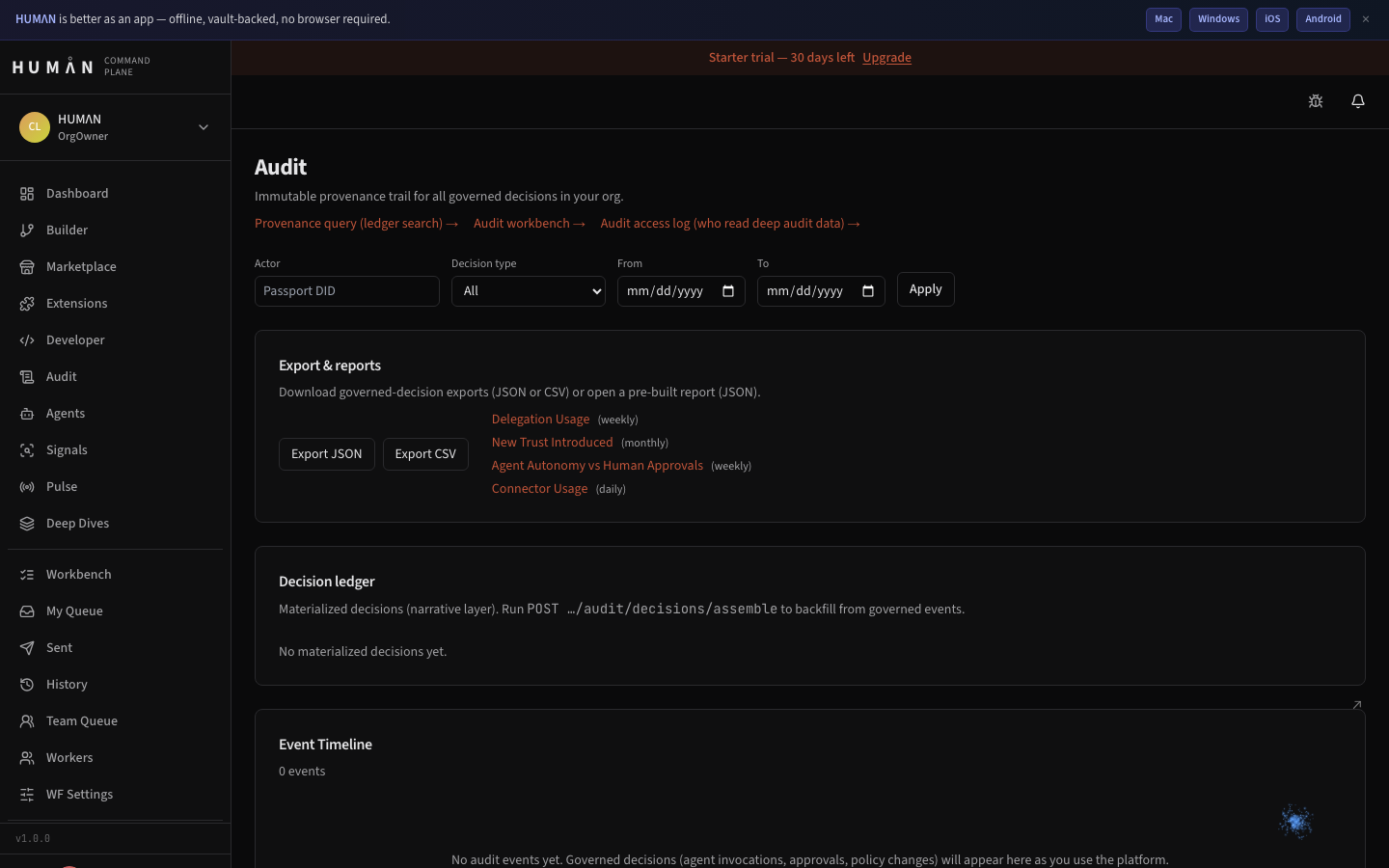
The product is live. Workflows run with human gates; every decision lands in a signed ledger you can open, inspect, and contest.

Latest perspectives
From the HUMΛN community and contributors.
Context Compact — start thin, fetch on demand
Context windows are not a strategy. Context Compact crushes redundant bulk for agents and Companion muscles — magic by default, CCR retrieve when you need the original, receipts for every crush. Not a proxy.
DeveloperCanon in the loop — scaffold, check, publish from MCP
The same agent that calls platform tools can human.canon.check and scaffold docs. Developer Tools + Canon MCP is governance that rides with the work.
DeveloperYour org is an MCP server — mesh, not a toy catalog
https://{org}.mcp.haio.run exposes workflows and agents as tools at catalog scale. This is the platform mesh — not a weather-demo MCP.