Capabilities

Deep enough to trust

HUMΛN should feel simple to enter and deep enough to trust. This page exists for the people who need to see everything.

Own · Build · Launch · Share · Govern · Grow

Level 1 language anyone can use — then the clusters below are the protocol substance for buyers and builders who need depth. Signals spans orchestration, governance, and Companion surfaces; see the Signals page for product depth.

Eleven capability clusters

Identity & access

Portable identity, delegation, and scoped access — you own the keys.

Primary audience: Everyone

Sign-in flows with cryptographic delegation and revocable scopes.

Try it: Connect your Passport and run a governed call in minutes — no shadow identity silo.

Passport

Capability & trust

Capability truth for routing — evidence-backed, not résumé theater.

Primary audience: Teams · Enterprise

Attested skills inform who — or what — may act on a high-stakes step.

Try it: Attach evidence to a capability node and watch routing respect it automatically.

Platform overview

Workflow & orchestration

Governed execution with human gates — Signals-informed routing spans clusters 3–4 and Companion.

Primary audience: Builders · Teams

Signals can route external change into workflows — same provenance as every other run.

Try it: Open the Builder, add a gate, deploy — governed run in under two minutes.

Workflows

Governance & oversight

Policy, approvals, and operational control — not a dashboard bolt-on.

Primary audience: Enterprise

Policy packs and approval queues ship with the Control Plane.

Try it: Attach a policy pack to a bundle and see enforcement on the next run.

Governance

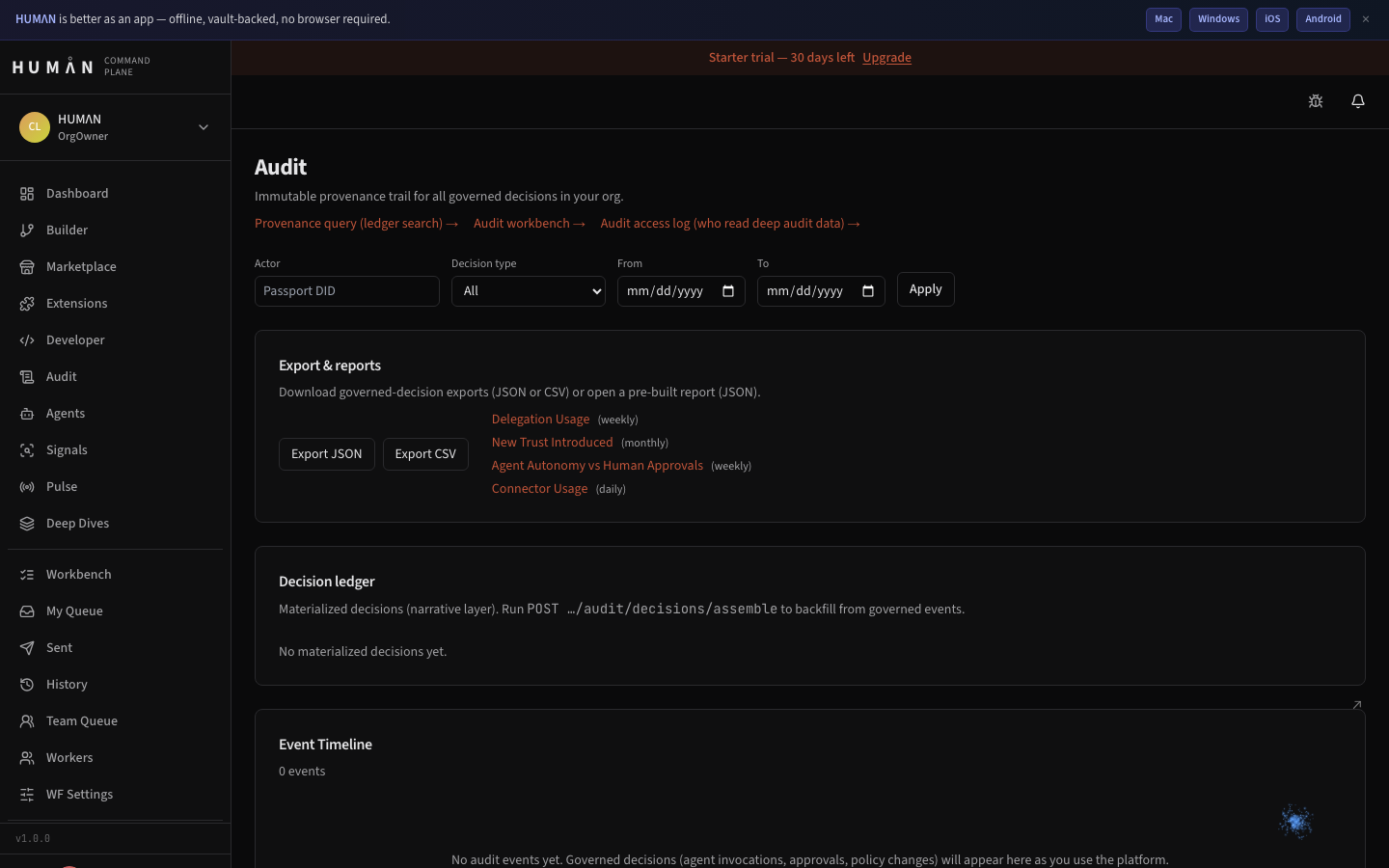
Provenance & audit

Know what happened, why it happened, who acted — and prove it anywhere.

Primary audience: Enterprise · Compliance · Developer

A hospital compliance lead opens the Decision Ledger and sees one curated narrative: AI triage → nurse review → physician override → outcome recorded with signed provenance — not 47 disconnected log lines.

Try it: Open Audit Explorer and trace one workflow run end to end.

Governance & audit surfaces

Marketplace & distribution

Installable bundles with governance included — publish once, inherit policy on install.

Primary audience: Builders · Teams

Install wizard enforces connector review before a bundle goes live in your org.

Try it: Install a governed bundle in two steps — policies and provenance travel with it.

Marketplace

Developer tooling & docs

SDK, CLI, guides, and reference wired to the same protocol contracts.

Primary audience: Developers

Four-line agent scaffold with provenance hooks — not a bespoke auth stack.

Try it: Run the CLI scaffold and deploy a hello-world governed workflow.

Developers

Connectors & services

Integrations at the boundary — scoped, auditable, and policy-aware.

Primary audience: Builders

OAuth connector inside a bundle with delegation-scoped secrets.

Try it: Add a connector step and watch policy gates apply before external calls.

Guides

Deployment & control

Hosted now — hybrid or self-hosted when your estate demands it.

Primary audience: Enterprise

Same manifest across HUMΛN Cloud (live) and beta hybrid/self-hosted programs.

Try it: Deploy to Cloud today; plan a boundary move without rewriting workflows.

Deployment models

Companion & apps

Natural-language interface to the full stack — not a disposable chat window.

Primary audience: Individuals · Teams

Ask Companion what happened in a workflow — grounded citations from audit and artifacts, not generic summaries.

Try it: Open Companion and ask for a decision receipt narrative in plain language.

Companion

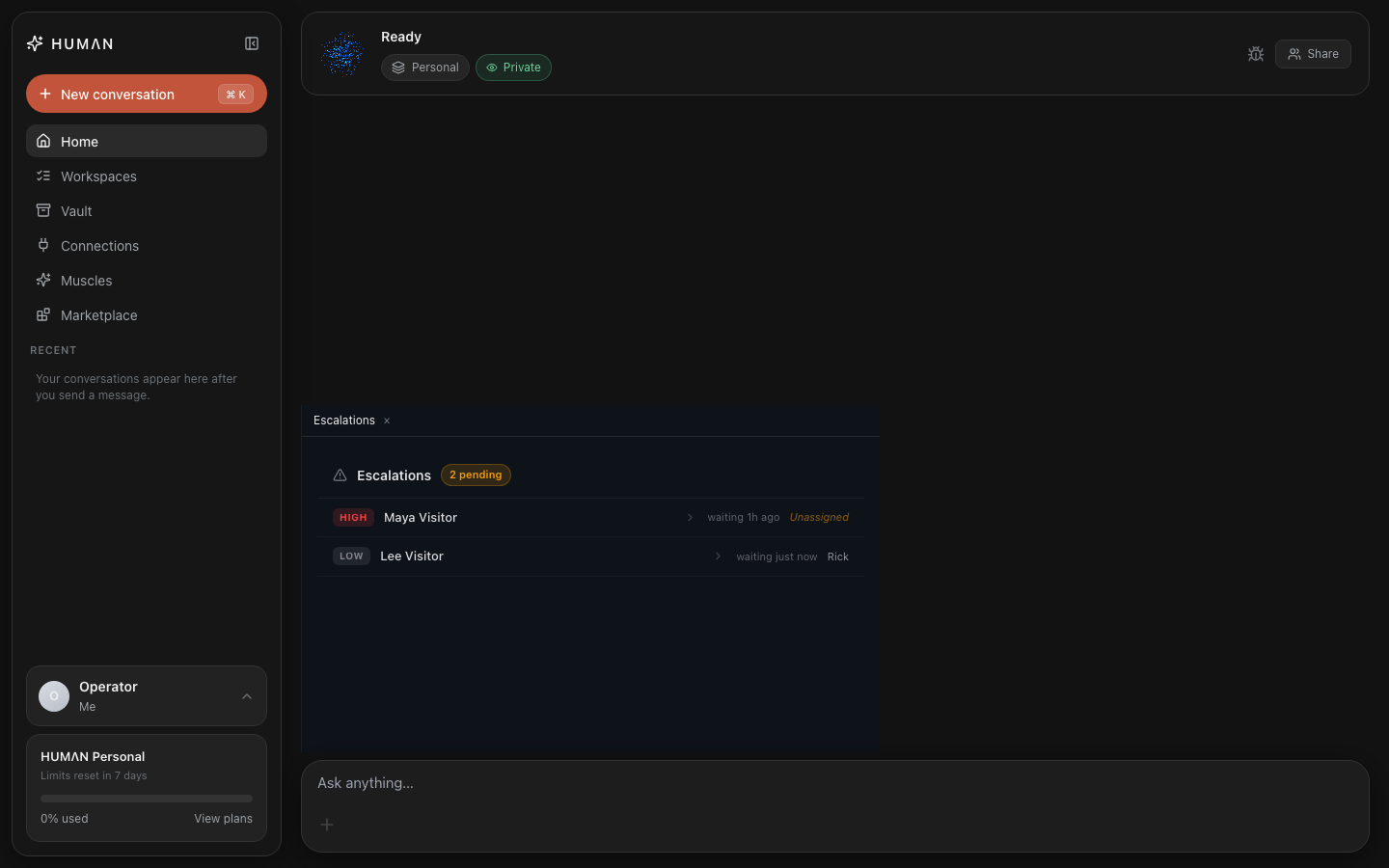
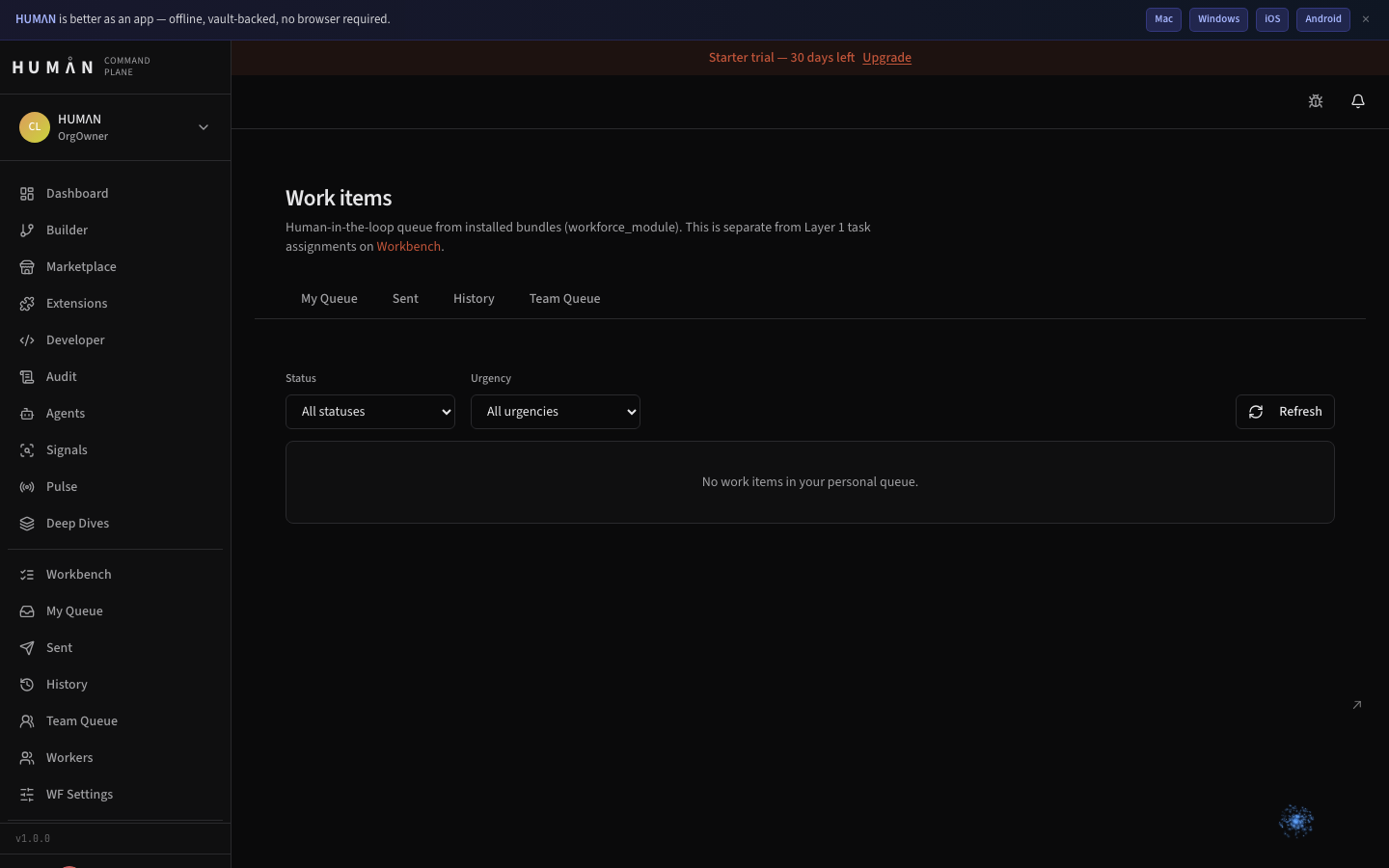
Human escalation / Workforce Cloud

When AI judgment is not enough, HUMΛN routes to the right human — your org today; verified external experts in closed beta.

Primary audience: Enterprise · Compliance · Team

A contract workflow flags unusual liability above confidence. It routes to a senior attorney in-org with the right attestation; they decide with full context — no handoff amnesia.

Try it: Follow an escalation from workflow → queue → recorded decision with provenance.

Workforce Cloud

Capability and trust — depth vs traditional hiring stacks

The Alternative: Rolling Your Own Capability System

Traditional systems trust agent self-reporting: "I can analyze financial data." Capability Graph requires proof.

Traditional Skill Verification

What you build:

  • Manual skill tagging system
  • Self-reported capabilities
  • Admin vetting workflows
  • Rating/review system
  • Skill expiration logic
  • Certification upload
  • Manual capability routing
  • Trust-based task assignment
Time: 4-8 months
HUMΛN

HUMΛN Capability Graph

What you write:

await capabilityGraph.grant({
  entity: agentPassport,
  capability: 'financial-analysis',
  evidence: [
    { type: 'certification', 
      issuer: 'CFA', 
      credential: '...' },
    { type: 'demonstration', 
      task: 'portfolio-opt', 
      result: {...} }
  ]
});

HUMΛN provides:

  • Evidence-backed verification
  • Cryptographic attestations
  • Automatic capability routing
  • Third-party proofs
  • Living skill graph
Time: 10 minutes

HumanOS automatically verifies before routing.

Agent claims capability → Capability Graph requires proof (certifications, demonstrations, third-party attestations).

This is how you safely delegate high-stakes tasks to AI.

HUMΛN Academy — continuous capability development and re-skilling — is coming. We do not list it as a live cluster today; the commitment is real and the availability is honest.

Why depth matters

Most agent stacks stop at orchestration. HUMΛN wires identity, capability truth, governance, provenance, and human escalation into one protocol — so evaluators can buy infrastructure, not a patchwork of promises.

Next steps for evaluators