Your rules. Enforced everywhere.
The enforcer, not the decision-maker
Most orchestration products want to make choices for you. HumanOS does the opposite: it takes the policies your organization already owns — who may act, on what, under which conditions — and enforces them consistently across humans and agents. It doesn't decide for you. It makes sure your decisions are followed.
Think AWS IAM, not an autonomous manager: a policy engine that enforces access rules without deciding what your policies should be. Or air traffic control — coordinating every flight according to established protocols, never choosing the destination.
How enforcement works
1. You define the rules
Policies, roles, routing logic, and escalation thresholds are configured by your organization — in manifests, policy packs, and delegation scopes.
2. HumanOS enforces them
Every call is checked against identity, capability, and delegation before it runs. Work routes to humans or agents based on the capability requirements you defined.
3. Escalation follows your policy
Based on your escalation policy, HumanOS involves a qualified human when confidence drops or stakes rise — with the same context the agent saw.
4. Receipts, always
Every decision lands in the Ledger with cryptographic provenance: who acted, under whose authority, and why. Inspectable, contestable, durable.
Built on the protocol primitives
HumanOS routes on truth, not titles. Passport answers who is acting. The Capability Graph answers what they can actually do — evidence-backed, not claimed. Delegations answer who authorized it. Provenance answers what happened. Every workflow, escalation, and approval composes those four answers.
Learning stays a governed event
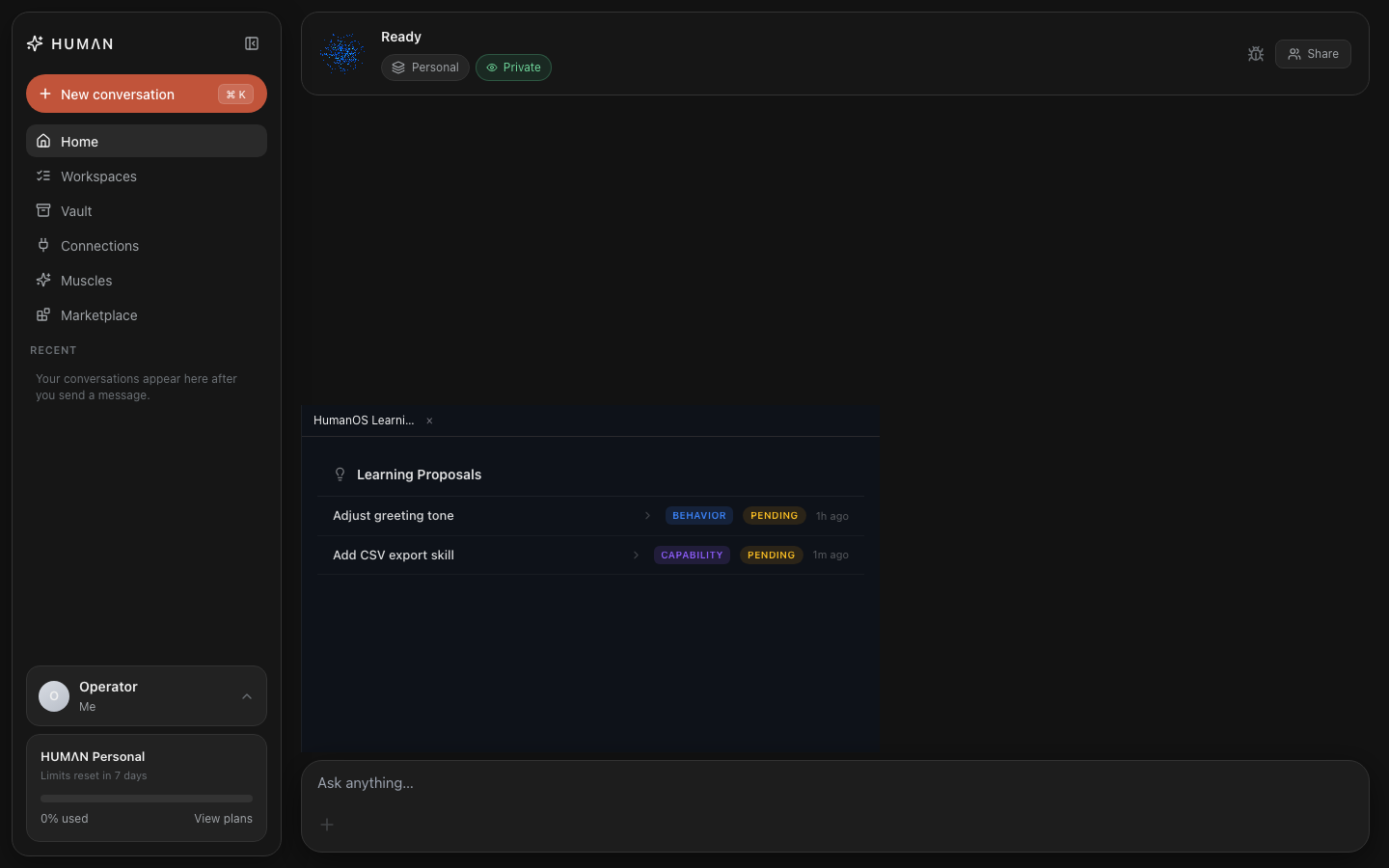
HumanOS can propose behavioral adaptations from what it observes — but proposals are all it makes. Humans approve, reject, or edit before anything changes, so improvement never becomes silent drift. Every accepted proposal is recorded with the same provenance as any other decision.
See it running
Workflows are HumanOS behavior you can watch: gates, routing, escalation, and receipts on live runs.